
Folk-Rock
Sombras de Granada
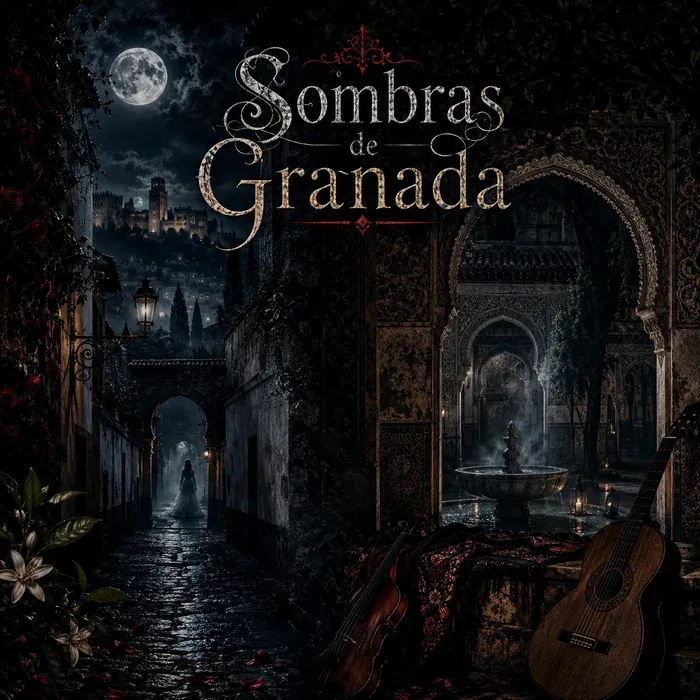
Sombras de Granada is dark Spanish-language folk rock with gothic weight: nylon guitars, shadowed percussion, violin, heavy riffs, and a night-walk story where Granada becomes memory, lover, ghost, and city at once.
- Tracks 14
- Length 49 min
Liner Notes
A short editorial read on the album world, sound, and standout moments.
About the Album
Sombras de Granada works best when it treats the city as a living memory rather than a backdrop. The album moves through Granada at night with Spanish vocals, nylon-string guitar, dark rock weight, violin, hand percussion, and choir-like shadows around the edges. Its mood is romantic, but not soft. There is always stone under the melody.
The story follows a poet who sees a woman before dawn and follows her through the city. That could become a simple ghost romance, but the album is more interesting when the woman feels less like a character and more like a pressure in the streets. She is desire, history, grief, and the city refusing to stay still. Every time the poet gets closer, the place around him seems to grow older.
“Calles de Granada” and “La Mujer del Alba” set the terms well: movement through narrow streets, a figure just ahead, and the sense that the night is already withholding something. “Guitarras Bajo la Luna” gives the record its most direct musical signature, letting the nylon guitar carry both elegance and unease. “Sombras de Al-Andalus” widens the frame without turning the past into simple decoration. The song works because memory feels unstable, not museum-clean.
The middle of the album is where the romance darkens. “El Poeta y la Fuente” keeps the story close to water and voice, while “Azahar Negro” turns beauty slightly poisonous. “Palacio de Ceniza” and “Velo de Seda y Sangre” bring heavier colors into the record: ash, silk, blood, and rooms where beauty has already paid a price. The rock elements are most effective when they do not overpower the folk textures. They give the songs weight, not volume for its own sake.
“Los Muros Recuerdan” is the album’s clearest thesis. Walls, towers, gardens, and fountains are not passive scenery here; they remember. “Bajo la Torre Roja” and “Cántico de los Jardines Oscuros” deepen that idea with a slower, more ritual feel. The female choirs work best in this stretch because they sound less like spectacle than an old presence coming through the stone.
The final songs pull the story toward morning without fully explaining it. “Cuando Despierta la Ciudad” lets daylight threaten the spell. “La Voz de Granada” gives the woman’s mystery a larger shape, as if the poet has been following the city’s own voice all along. “Nadie Sabe Si Vivió” is the right ending because it leaves a trace rather than a solution. The poet may have found the city, lost himself, or become another story told before sunrise.
Sombras de Granada is strongest as gothic folk rock about longing that has a place, a temperature, and a set of sounds: plucked strings, low drums, dark riffs, violin, and a voice moving through stone. It does not need to prove that Granada is haunted. It only needs to make the listener believe that some cities keep singing after everyone has gone home.
Production Notes
All tracks were generated with AI music models, then processed for the final sound. No human performance recordings are used.

La Sangre del Sol
Spanish folk rock with scorched guitars, village-square drama, and a rebel story shaped by drought, stolen water, public song, and dawn.

Neon Hearts
K-pop and synthpop for Seoul after midnight. Sharp beats, clean hooks, and rain-lit city images trace romance from first spark to dawn.

Cuore di Napoli
Cuore di Napoli is Italian folk pop with mandolin, accordion, acoustic guitar, tamburello rhythm, and a street-level story about family, poverty, love, pride, and a young musician learning what his city has given him.

Luz de Cempasúchil
A Mexican pop and Latin ballad record in Spanish, built on nylon guitar, piano, and trumpet. A woman travels from the city back to her village for Día de Muertos and reads her way through a drawer of old letters.